
If you've been using the sauna and not feeling much from it, the answer is almost always one of three things: it's not hot enough, you're not in long enough, or you're not going often enough.
That's it. That's most of the puzzle.
The good news is that sauna is one of the best-studied recovery tools we have, and the protocol that works is genuinely simple. Once you dial in the temperature, time, and frequency, the benefits start showing up — better sleep, faster recovery, lower stress, and a long list of long-term health markers backed by decades of Finnish research.
Here's what the research says, and how to actually put it into practice.
What the Research Actually Says
The most-cited sauna research comes out of Finland, where the Kuopio Ischemic Heart Disease (KIHD) study followed more than 2,300 middle-aged men for about 20 years and tracked their sauna habits alongside their long-term health outcomes (Laukkanen et al., JAMA Internal Medicine, 2015). The pattern that showed up was striking.
Frequent sauna users also showed lower rates of cardiovascular disease, stroke, and dementia. A follow-up analysis of the same KIHD men (Laukkanen et al., Age and Ageing, 2017) found that those using the sauna 4–7 times a week had a 66% lower risk of dementia and a 65% lower risk of Alzheimer's than once-a-week users. A separate, larger Finnish study then looked at whether temperature changes that picture — and it does. More on that in a minute.
None of this is a quick fix or a miracle. It's the result of consistent, low-key heat exposure over time. Which is exactly the kind of habit a sauna routine is built for.
What's Happening to Your Body in There
When you sit in a hot sauna, your body responds a lot like it does to moderate cardio. Your heart rate climbs, blood vessels dilate, and circulation increases. Your core temperature rises a couple of degrees, which is the part that matters most.
That rise in core temperature triggers a class of repair molecules called heat shock proteins. They help refold damaged proteins inside your cells, protect neurons, and seem to be one of the main reasons sauna use is linked to better long-term brain and cardiovascular health.
Heat shock proteins are produced when your body is exposed to meaningful heat stress. They help repair misfolded proteins, support neuron health, and are one of the leading explanations for why regular sauna use is associated with lower rates of Alzheimer's and dementia in the Finnish cohort studies.
You'll also get a dose of relaxation that's hard to fake — your nervous system shifts out of "go" mode, cortisol drops, and most people walk out feeling noticeably calmer than when they walked in. That part isn't subtle.
The Protocol That Actually Works
Here's the simple version. If you do these four things, you're in the zone where the research shows real benefit.
Temperature: 176–210°F (and not above)
This is one of the most important — and most misunderstood — variables. For years the assumption has been "the hotter, the better." The research says otherwise.
A Finnish study by Knekt et al., published in 2020, followed nearly 14,000 men and women for up to 39 years. People who used the sauna 9–12 times a month had a 53% lower risk of dementia during the first 20 years of follow-up (and about 19% lower across the full 39 years) compared to people who used it fewer than four times a month or not at all. The most favorable conditions in the data were temperatures between 176–210°F (80–99°C) with stays of 5–14 minutes in the heat.
But here's the part most people don't know: people who used the sauna at temperatures above 212°F (100°C) had roughly double the dementia risk during the first 20 years of follow-up, compared to those staying below 176°F. Hotter wasn't just "less helpful." It was actively associated with more risk.
Knekt et al., "Does sauna bathing protect against dementia?" published in Preventive Medicine Reports, 2020. Open-access and peer-reviewed — and much larger and longer than earlier sauna-and-dementia research, and the first to include women. Read the full paper here.
We run our sauna at 195°F — right in the heart of that protective range. Hot enough to do what heat is supposed to do, dialed in well below the threshold where the benefits start working against you.
Duration: 15–20 minutes per session
A lot of people leave at the 10-minute mark, right when their body is starting to do the interesting work. In the KIHD heart data, men whose sessions lasted about 19 minutes or more had lower cardiovascular risk than those who stayed under 11 minutes. Aim for 15–20 minutes of total time in the heat — split into a couple of rounds with a cool-down in between if that's more comfortable. Our sessions are 30 minutes long, which gives you space to settle in, take a breath outside if you need to, and finish without rushing.
Frequency: aim for 3–4+ times per week
This is the variable that matters most, and it's the one most people underestimate. Once a week is mostly a nice ritual — the data shows pretty modest effects there. Two to three times a week is where the meaningful shifts start, and four to seven times a week is where the biggest numbers in the KIHD data show up.
This is also why our membership includes free sauna with every tier — frequency is the whole game, and pricing it per session works against the thing that actually helps you.
Hydration: drink before and after
16–24 oz of water before your session, and at least that much after. You'll sweat more than you think, and being even mildly dehydrated will make the session feel rougher and dull the benefits. (Also worth reading: what to wear in a sauna — small details that make a noticeable difference.)
Sauna is included with every membership
Free sauna, up to 2x per day. No credits, no add-ons. Memberships start at $69/month.
See memberships → Book a drop-in ($13)If You Want to Go a Step Further: Add Cold
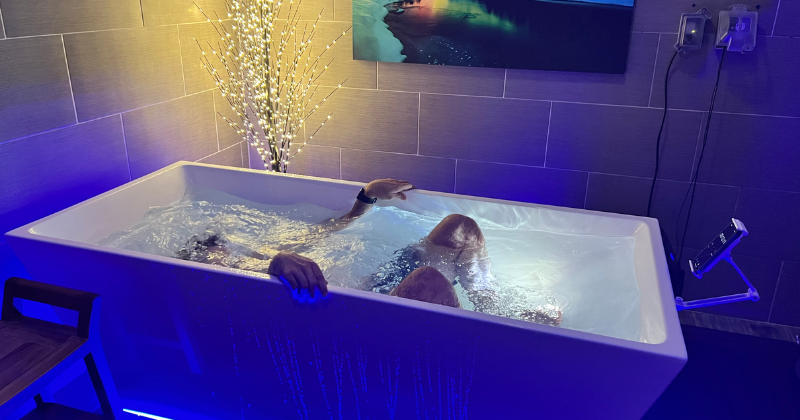
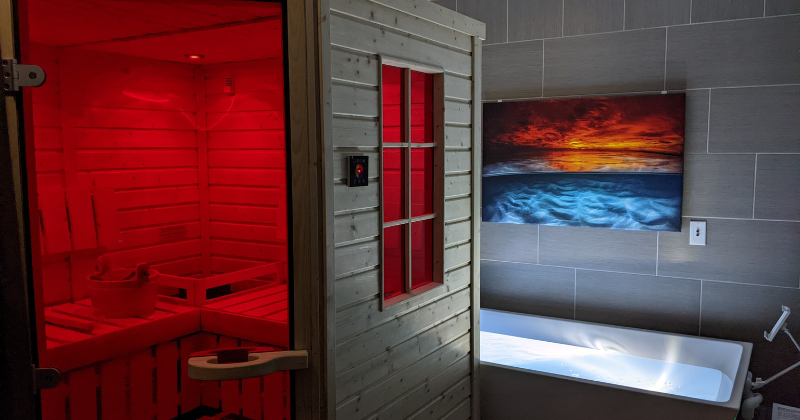
If you want to get more out of each visit, pair your sauna with a cold plunge afterward. Going from hot to cold gives your blood vessels a workout that neither one does on its own, and a lot of people find recovery from workouts (or just life) feels noticeably better when they alternate the two. Our Fire & Ice suite is set up for exactly this — sauna, then plunge, then back again if you want.
You don't have to do this to get value from the sauna. But if you're already in, it's an easy upgrade.
How We Run It at Lost in Float
A few things that matter to us:
- Traditional Finnish sauna, not infrared. The major longevity studies were done on traditional saunas at high temperatures, so that's what we built. They're different tools, and we wanted to match the one with the research behind it.
- 195°F, every time. Consistent, dialed in to the heart of the research-backed protective range (176–210°F) — hot enough to deliver real benefit, well clear of the temperatures where the science starts working against you.
- Spotless. Our customers mention this in reviews without being asked, and we take it as a serious compliment. A clean sauna shouldn't be unusual, but it often is.
If you've tried saunas before and weren't sure what the fuss was about, give the protocol a real shot for a few weeks. Most people are surprised by how much changes once frequency gets up to three or four times a week.
Lost in Float | 8244 Northern Lights Dr, Lincoln NE | 531.289.7739 | Open Tuesday–Sunday 9am–9pm