850nm vs 980nm Red Light: What's the Difference and Does It Actually Matter?
Both wavelengths work. But they work in completely different ways — and knowing which is which might change how you think about red light therapy entirely.

If you've ever looked at the specs on a red light therapy device and seen numbers like "850nm" or "980nm," you've probably wondered: what does that actually mean, and should I care?
The short answer is yes — but not in the way most people think. It's not that one wavelength is better than the other. It's that they work through completely different biological pathways, targeting different parts of your cells entirely. Understanding that difference helps you understand why red light therapy produces such a wide range of benefits across seemingly unrelated conditions.
Let's break it down in plain English.
First — what is a wavelength, really?
Light is just energy moving in waves. The wavelength is simply the distance between those waves — measured in nanometers (nm). Different wavelengths carry different amounts of energy and interact with the body in different ways.
Visible red light sits around 630–700nm — you can actually see it as a deep red glow. Near-infrared light (NIR), which includes 850nm and 980nm, is invisible to the naked eye but penetrates deeper into tissue. This is the range most serious red light therapy devices operate in, and it's where most of the interesting science happens.
This post focuses on the near-infrared range — specifically 850nm and 980nm. Both are well-studied, both are used in clinical and wellness red light therapy, and both produce real measurable effects. They get there through entirely different mechanisms, which is what makes the comparison genuinely interesting rather than just a marketing numbers game.
850nm: The mitochondrial powerhouse
When red light therapy researchers talk about 850nm — or the broader 810–850nm range — they're usually excited about one specific target: cytochrome c oxidase (CCO), also known as Complex IV of the mitochondrial electron transport chain.
CCO is an enzyme inside your mitochondria — the energy-producing structures in every cell. Think of it as the final stop on your cell's power line. Research by Karu (2010), who is widely regarded as the foundational figure in photobiomodulation science, established CCO as the primary photoacceptor for red and near-infrared light — meaning it's the molecule that absorbs the photons and triggers the downstream cellular response. When 850nm light hits CCO, it boosts the production of ATP — the molecule your cells use as fuel.
A comprehensive 2021 review of light parameters and PBM efficacy (Wang et al.) confirmed that over 50% of light absorption between 800 and 850nm is attributable to cytochrome c oxidase, with hemoglobin playing a comparatively minor role. This explains why the 810–850nm range has emerged as the backbone of photobiomodulation research — CCO is a reliable, well-characterized photoacceptor at these wavelengths.
More ATP means cells have more energy to do their jobs: repairing tissue, fighting inflammation, producing collagen, recovering from stress. This mitochondrial pathway is why 850nm is the go-to wavelength for general recovery, muscle repair, joint support, and broad anti-inflammatory effects. It's the workhorse of red light therapy, supported by decades of research.
980nm: A completely different mechanism
Here's where it gets genuinely interesting. When you move to 980nm, you're no longer primarily targeting mitochondria — you're targeting water.
Your cells are mostly water, and water absorbs 980nm light particularly well. When that absorption happens, it creates subtle thermal and photochemical effects that activate a family of ion channels — specifically TRPV1 and TRPC channels. These are heat- and light-sensitive channels that, when activated, trigger calcium signaling inside the cell.
The definitive study establishing this distinct mechanism was published by Wang et al. (2017) in Scientific Reports, which directly compared 810nm and 980nm on human adipose-derived stem cells. The researchers found that while both wavelengths promoted cell proliferation, they operated through completely separate pathways — 810nm worked via mitochondrial ATP production, while 980nm increased cytosolic calcium and its effects could be blocked by TRPV1 and TRPC channel inhibitors. Critically, those same inhibitors had no effect on the 810nm response. This confirmed that the mechanisms are not just different in degree — they're different in kind.
"850nm is your cell's battery charger. 980nm is more like flipping a switch on your nervous system."
Calcium signaling is essentially the cell's internal communication system. It regulates cell proliferation, tissue repair, and crucially, neuromodulation — the ability to influence how nerves fire and how pain signals are transmitted. Hamblin's widely cited 2017 review on photobiomodulation and anti-inflammatory mechanisms confirmed that light-activated TRP ion channels — including the TRPV1 family — produce calcium influx that modulates the inflammatory response at a cellular level.
This is why 980nm has shown particular promise in research on pain management and myofascial conditions. Studies have found it effective for trigger point therapy and burning mouth syndrome — conditions where nerve activity and calcium-mediated signaling play a central role. The Wang et al. study's demonstration that 980nm effects can be blocked by calcium channel inhibitors is direct mechanistic evidence, not just correlation.
What about penetration depth?
This is the question everyone asks, and the honest answer is: it's more complicated than "deeper is better."
The optical window — the range where light penetrates tissue most efficiently — peaks around 800–850nm, where absorption by hemoglobin and melanin is lowest. Wang et al. (2021) confirmed that over 50% of absorption in this range is due to CCO rather than hemoglobin — giving 850nm a measurable advantage in raw transmission through certain tissues.
However, 980nm's water absorption gives it a different kind of advantage in high-power applications. Because it interacts with water throughout the tissue rather than just at the surface, it can produce meaningful effects at depth through water-mediated pathways. Research also suggests 980nm performs particularly well in people with darker skin tones, where melanin creates more interference at shorter wavelengths.
The practical takeaway: neither wavelength universally "wins" on penetration. The better question is which pathway is most relevant to your goal.
The side-by-side breakdown
| Aspect | 850nm | 980nm |
|---|---|---|
| Primary target | Cytochrome c oxidase (CCO) in mitochondria | Water → TRPV1/TRPC ion channel activation |
| Key mechanism | ATP boost, reduced oxidative stress, anti-inflammation | Calcium signaling via TRPV1/TRPC, neuromodulation, cell proliferation |
| Best for | General recovery, muscle/joint support, broad anti-aging | Pain relief, trigger points, neuromodulation, wound healing |
| Penetration | Strong in optical window — 50%+ absorption by CCO at 800–850nm | Comparable via water-mediated pathways; advantage with darker skin tones |
| Research base | Decades of established research; Karu, Hamblin, and others | Newer but growing; Wang et al. 2017 confirms distinct mechanism |
| Better together? | Yes — they complement each other | Yes — synergistic when combined |
So which one does Lost in Float use?
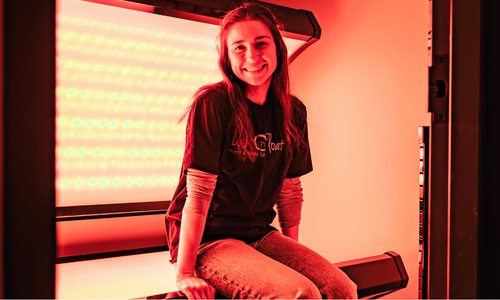
Our full-body red light beds use a combination of wavelengths — including both near-infrared ranges — specifically because the research supports a multi-wavelength approach. When both pathways are activated together, you get mitochondrial stimulation and ion channel activation simultaneously. The result is more comprehensive than either wavelength could produce alone.
Our beds are clinic-grade, meaning the irradiance — the actual power delivered to your tissue — meets the thresholds shown to be effective in published research. A device with the right wavelengths but insufficient power won't produce the same results. It's not just what wavelengths are present, but how much light is actually reaching your cells.
Experience it for yourself
Full-body red light at Lost in Float — clinic-grade beds, multiple wavelengths, private suite. Lincoln NE. Open Tuesday–Sunday 9am–9pm.
Book a session → See membershipsThe bottom line
850nm and 980nm aren't competitors — they're colleagues. 850nm excels at the mitochondrial level, boosting cellular energy and driving broad recovery and anti-inflammatory effects. 980nm works through a fundamentally different route, using water and ion channels to modulate pain signaling and support specific healing applications.
Neither is universally superior. Understanding how they differ helps you ask better questions when evaluating red light therapy options — and helps you understand why a well-designed full-body system produces effects across such a wide range of conditions. The science isn't complicated once you strip away the jargon. Your cells have multiple ways to respond to light. The best systems use multiple wavelengths to activate all of them.
Karu TI (2010) — Multiple roles of cytochrome c oxidase in mammalian cells under action of red and IR-A radiation. IUBMB Life, 62(8):607–610. The foundational paper on CCO as the primary photoacceptor for red/NIR light.
Wang Y et al. (2017) — Photobiomodulation of human adipose-derived stem cells using 810nm and 980nm lasers operates via different mechanisms of action. Scientific Reports. The key study demonstrating that 980nm operates via TRPV1/TRPC calcium channels, not CCO — with inhibitor confirmation.
Wang Y et al. (2021) — Review of light parameters and photobiomodulation efficacy. Journal of Biomedical Optics. Confirms 50%+ of 800–850nm absorption is due to CCO, and that 980nm mechanism relies on water absorption and ion channel activation.
Hamblin MR (2017) — Mechanisms and applications of the anti-inflammatory effects of photobiomodulation. AIMS Biophysics. Covers TRP ion channel activation by light, calcium influx, and downstream anti-inflammatory signaling.