Red Light Therapy for Weight Loss
There's real research behind red light therapy and fat loss — and real limits to what it can do on its own. Here's an honest look at the science, the mechanism, and how to use it effectively.

If you've searched "red light therapy weight loss" recently, you've seen everything from skeptical dismissals to breathless claims about melting fat while you lie still. Neither extreme is particularly useful. The research on red light therapy and body composition is more nuanced than either camp suggests — and more interesting.
Red light therapy is not a replacement for the fundamentals of fat loss. It's not a shortcut. What the evidence does show is that at the right wavelengths and doses, red light therapy affects fat cells, metabolic function, and recovery in ways that can meaningfully support a body composition goal — particularly when paired with exercise and other recovery-focused practices.
This is a thorough look at the mechanism, the evidence, realistic expectations, and what you can practically do with it — whether you're in Lincoln or anywhere else.
What Red Light Therapy Actually Is
Red light therapy — technically called photobiomodulation (PBM) — uses specific wavelengths of red and near-infrared light to penetrate tissue and trigger biological responses at the cellular level. The light is absorbed by mitochondria, which use the energy to produce more adenosine triphosphate (ATP) — the cell's primary energy currency.
This is not heat, tanning, or UV exposure. The wavelengths used in clinical red light therapy — typically 630–680nm for red and 800–850nm+ for near-infrared — pass through skin and penetrate to varying tissue depths without causing damage. The effect is photochemical, not thermal. See our detailed comparison of 980nm vs 850nm NIR and why penetration depth matters →
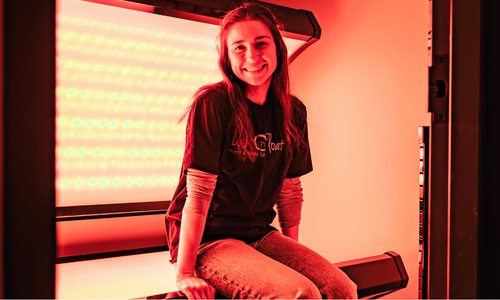
Three parameters determine whether a red light session produces a therapeutic effect: wavelength (nm), irradiance (mW/cm² — the power density hitting the tissue), and fluence (J/cm² — the total energy dose delivered). Low-powered consumer devices often deliver irradiance far below what study protocols use, which is why session time alone doesn't tell the whole story. Clinical-grade full-body beds use multiple wavelengths at therapeutic irradiance levels across the entire body surface simultaneously. Our bed at Lost in Float uses 10 wavelengths across both the red and near-infrared spectrum — multi-wavelength coverage matters because different wavelengths penetrate to different tissue depths, reaching both superficial and deeper fat deposits. Read the full breakdown of wavelengths, irradiance, and what separates clinical from consumer devices →
The full-body format is also significant. Studies on body composition use whole-body or large-area exposure, not localized treatment of a single area. Spot-treating a specific zone with a small panel is not the protocol the fat-loss research is based on.
How Red Light Therapy Affects Fat Cells
The most well-documented mechanism for red light therapy's effect on fat involves a process called adipocyte lipolysis — the release of stored lipids from fat cells. Here's what the research shows happens:
When red light triggers the release of lipids from fat cells, those lipids enter the bloodstream and become available as fuel. If you're sedentary after a session, they can simply be reabsorbed. This is why the research consistently shows stronger results when sessions are followed by physical activity — even a 20–30 minute walk is enough to put those mobilized lipids to use. Red light therapy is best understood as a fat mobilization accelerator, not a fat eliminator.
What the Research Shows — and Its Limits
The clinical evidence on red light therapy and body composition has grown meaningfully, but it deserves an honest review — including where the limitations are.
Key studies
A 2011 study in Lasers in Surgery and Medicine (Caruso-Davis et al.) found that participants receiving red light alongside a calorie-restricted diet lost significantly more girth than those on diet alone — specifically waist, hip, and thigh circumference. A 2013 randomized controlled trial (Nestor et al.) found that full-body red light combined with exercise produced greater reductions in body fat percentage and waist circumference compared to exercise alone over 8 weeks. A large retrospective analysis by Jackson et al. (2012) of 689 participants found a mean combined circumference reduction of 3.27 inches across waist, hips, and thighs after just six treatments.
A 2025 systematic review and meta-analysis of 11 RCTs (569 patients) found consistent support for PBM as an adjunct to diet and exercise — with improvements in BMI, waist circumference, and inflammatory markers. Effect sizes were modest but clinically meaningful, particularly for abdominal fat. Fat percentage drops are real but typically modest on their own; the amplification effect when added to exercise is where the more significant changes occur.
Where to be skeptical
Many early studies in this space are small, industry-linked, or short-term. Long-term data beyond 6 months is limited. Most fat-loss studies were conducted on participants in the overweight to Class I obese BMI range — results for those with higher starting body fat or those making no lifestyle changes are less consistent. Individual variability is also real: red light appears more effective for localized stubborn fat in otherwise active people than as a primary intervention for significant weight loss without lifestyle change.
Results also vary by age, sex, hormonal status, starting body composition, and adherence. It's not a universal tool — it's a precision one.
Clinical Grade vs. At-Home Devices: Why It Matters
The gap between clinical red light therapy and consumer devices is significant — and relevant if you've tried a panel or wand at home and noticed limited results.
| Clinical full-body bed (Lost in Float) | Typical at-home panel | |
|---|---|---|
| Wavelengths | 10 wavelengths (red + near-infrared spectrum) | 1–3 wavelengths |
| Coverage | Full body, front and back simultaneously | Small area, one side at a time |
| Irradiance | Therapeutic mW/cm² matching research protocols | Often well below therapeutic threshold |
| Fluence (dose) | Calibrated J/cm² per session | Highly variable; often underdosed |
| Session time | ~15 minutes at therapeutic irradiance | Often 20–40 min per area to compensate |
| Cost over time | Per-session or membership — no upfront device cost | $300–$1,500+ device that may underdeliver |
The studies that documented meaningful fat reduction used clinical-grade, high-irradiance, full-body protocols. The results from those studies don't transfer to underpowered consumer devices, regardless of how they're marketed.
Red Light vs. Other Fat Loss Tools
For context on where red light sits relative to other body contouring and fat loss tools:
- Cryolipolysis (CoolSculpting): Destroys fat cells permanently in a localized area. More aggressive than red light, higher cost per session, longer recovery, not appropriate for general fat loss — only spot reduction. Red light is non-destructive and works systemically.
- EMS (electrical muscle stimulation): Stimulates muscle contractions. Addresses muscle tone rather than fat mobilization directly. Complementary to red light rather than competitive.
- Ultrasound cavitation: Uses sound waves to rupture fat cells. Similar mechanism to red light (lipid release) but more aggressive. Limited long-term data.
- GLP-1 agonists (semaglutide/Ozempic/Wegovy): Produce significant weight loss in many people, but carry a substantial side effect profile. Nausea, vomiting, diarrhea, constipation, and fatigue are common — particularly during dose escalation. More serious reported effects include gastroparesis (stomach paralysis), pancreatitis, and significant muscle mass loss alongside fat loss, which can worsen long-term metabolic health. Weight frequently returns when the medication stops. Red light therapy is not in the same category as a weight loss intervention. However, for people already on GLP-1s, pairing red light therapy with strength training may help address one of the key downsides — the muscle mass loss that these medications can accelerate.
How to Use Red Light Therapy Effectively
Based on the research, here's how red light therapy produces the best results for body composition:
Frequency and timing
- Frequency: 3 sessions per week during an active phase (8+ weeks). After that, 1–2 sessions per week for maintenance.
- Timing: Before or immediately after exercise is optimal. The mobilized lipids are available as fuel during the workout. A brisk 20–30 minute walk post-session also suffices if a full workout isn't possible.
- Track progress by measurements, not just the scale: Waist, hip, thigh, and arm circumference; photos; and body fat percentage (DEXA or ultrasound ideal) give a clearer picture than weight alone, since muscle gain can offset fat loss on the scale.
Synergistic stack
- Diet: A calorie deficit or high-protein diet amplifies the use of mobilized fat. Without dietary support, the lipids released from fat cells are more likely to be reabsorbed.
- Sauna: Raises metabolic rate, produces cardiovascular stress that burns additional calories, and activates heat shock proteins. Addresses fat loss through a completely different pathway than red light — the two compound each other.
- Cold plunge: Activates brown adipose tissue (thermogenesis), which directly burns fat for heat. The norepinephrine release also improves mood and motivation, which supports consistency.
- Strength training: Builds lean muscle, which permanently raises resting metabolic rate. This is the single most durable body composition intervention — red light supports recovery between sessions and may enhance muscle repair.
- Sleep and stress management: PBM aids cellular recovery and has documented effects on sleep quality. Poor sleep and high cortisol actively impair fat metabolism — addressing both through float therapy, sauna, and red light creates a hormonal environment that supports body composition goals.
- Hydration: Drink water before and after sessions. Mobilized lipids are transported through the lymphatic system and bloodstream — hydration supports clearance.
Who it works best for
Red light therapy for body composition produces the most consistent results in: active people who have plateaued despite diet and exercise; post-pregnancy body composition changes; people managing inflammation or thyroid issues that impair metabolism; and anyone looking to improve body composition without aggressive intervention.
Cellulite and Skin Tightening
A consistent secondary benefit reported in fat loss studies is improved skin quality in treated areas. As fat cells shrink and release their contents, the overlying skin often shows reduced cellulite appearance, improved texture, and increased firmness — driven by the collagen-stimulating effects of red and near-infrared light on fibroblasts. This isn't a cosmetic side effect; it's part of the same photobiomodulation process affecting the tissue below.
For people specifically targeting cellulite or skin tightening alongside body composition, red light is one of the better-evidenced non-invasive options. The collagen and elastin production effects are well-documented across the dermatology literature independently of the fat loss research. Read the full guide to red light therapy for skin, collagen, and anti-aging →
Try clinical red light therapy in Lincoln
10 wavelengths. Full-body clinical-grade bed. Private suite. ~15 minute sessions. Book a single session or include it in your membership.
Book now → See membershipsHonest Expectations
Red light therapy is not a weight loss treatment. It does not produce fat loss in the absence of other factors. What the evidence shows it can do — at clinical grade, with consistency, paired with appropriate activity — is:
- Accelerate the mobilization of stored fat, making it more available as fuel
- Contribute 1–3.5+ inches of combined circumference reduction over 4–8 weeks when paired with diet and exercise
- Produce modest but meaningful fat percentage reductions as an exercise adjunct
- Support faster recovery from exercise, enabling more consistent training
- Reduce inflammation that impairs metabolic function
- Support thyroid function, which influences metabolic rate
- Improve skin tightness, collagen density, and cellulite appearance
- Aid sleep quality and stress recovery, supporting the hormonal environment for fat loss
Effects may partially reverse without maintenance sessions. For people actively working on body composition — eating well, exercising consistently — red light therapy is a meaningful adjunct the research supports. For people who aren't doing those foundational things, it won't compensate. That's the honest version.
Frequently Asked Questions
Caruso-Davis MK et al. (2011) — Efficacy of low-level laser therapy for body contouring and spot fat reduction. Obesity Surgery, 21(6):722–9.
Nestor MS et al. (2013) — Effect of 635nm low-level laser therapy on upper arm circumference reduction: a double-blind, randomized, sham-controlled trial. J Clin Aesthet Dermatol, 5(2):42–48.
Jackson RF et al. (2012) — Application of low-level laser therapy for noninvasive body contouring. Lasers in Surgery and Medicine, 44(3):211–17.
Systematic review and meta-analysis (2025) — Effectiveness of photobiomodulation therapy in improving health indicators in obese patients: 11 RCTs, 569 patients. PubMed.