Sauna in Summer
Most people put the sauna away when it hits 90°F outside. The research says summer is exactly when it delivers the most — for cardio fitness, immune resilience, and the kind of heat adaptation you'll feel every time you step outside.

The most common thing we hear in July: "I'll come back when it cools off." It makes intuitive sense. When it's already 90°F outside, why walk into a room that's 195°F?
Here's what the research quietly suggests: summer is not the wrong time to sauna. It might be the best time. What sauna actually does — for your cardiovascular system, your immune system, and how your body handles heat in daily life — happens more effectively when you're already spending time in warm weather. And the benefits carry forward into cold and flu season in ways most people don't realize.
This post walks through what the research shows, what it doesn't, and how to think about summer sauna use honestly. It's science-backed and — as always — we'll be clear about the limits.
A quick note. Sauna at Lost in Float is a wellness service, not a medical treatment. We don't make disease claims. The studies below were conducted in specific populations at specific temperatures — where relevant, we'll flag how our sauna compares. If you have a heart condition, are pregnant, or take medications that affect blood pressure or hydration, you'll need clearance from your provider before starting sauna use.
Why Summer Is Actually the Right Time
The instinct to skip sauna when it's hot outside is a reasonable one — but it misses what sauna does at the physiological level. Sauna isn't just heat exposure. It's a controlled stressor that trains your body to handle heat better in every other setting. And when your daily life already includes warm weather, the adaptations from your sessions get reinforced instead of losing their edge.
Think of it like this: your cardiovascular system's job in heat is to move blood — and the heat it carries — from your core out toward your skin so you can radiate it away. That's the physiology of thermoregulation. When you sauna regularly, your body gets measurably better at that process. Plasma volume increases. Sweat starts earlier and more efficiently. Skin blood flow improves. Your resting heart rate at a given ambient temperature drops.
The practical result, in plain language: after a few weeks of consistent summer sauna use, walking outside on a 90°F afternoon feels different. Not because the temperature changed — because you did.
In summer, your body is already doing the work of thermoregulating almost every day. Adding sauna doesn't overload the system — it trains it, in the same way progressive resistance training makes you stronger. Winter sauna is a novel stressor. Summer sauna is progressive training on a system that's already engaged.
Sauna + Exercise: The Study Nobody Talks About
Most sauna coverage focuses on cardiovascular mortality studies. Those matter, but there's a smaller randomized controlled trial that's arguably more useful for how you actually train and recover in day-to-day life.
In 2022, a research team led by Prof. Jari Laukkanen — the Finnish researcher behind most of the landmark sauna cohort studies — published an eight-week randomized controlled trial in the American Journal of Physiology. They took 47 sedentary adults with at least one cardiovascular risk factor and assigned them to one of three groups: guideline-based exercise plus a 15-minute post-exercise sauna three times per week, exercise alone, or a control group with neither.
To put that in context: separate research from the Laukkanen lab found that participants above the median VO2 max in a large Finnish cohort had a 35% reduction in all-cause mortality compared to those below the median. VO2 max isn't just a fitness metric. It's one of the most reliable predictors of how long — and how well — you live.
The sauna in the Lee et al. trial started at 65°C (149°F) and increased 5°C every two weeks — considerably cooler than our traditional Finnish sauna, which runs at 195°F. The study was also small (47 people) and short (8 weeks). Directionally, the finding — that regular post-exercise sauna produces cardiovascular adaptations exercise alone doesn't — is consistent with what we know about heat adaptation biology. But the exact effect sizes came from a milder protocol than what you'd experience with us.
Practically, this is why so many of our members pair Tonal or a workout with a sauna round after. It's not a hack — it's a well-supported combination that appears to compound in a way neither modality does alone.
What a Sauna Session Does to Your Immune System
This is the newer piece of the summer story. Earlier in 2026, another study from the Laukkanen lab looked at what happens to immune cells during and after a Finnish sauna session. The finding is worth understanding on its own terms — because it's both more interesting and more limited than the wellness headlines often suggest.
In the study, 51 middle-aged adults sat in a 73°C (163°F) Finnish sauna for 30 minutes, with a brief cold shower midway through. Researchers measured white blood cell counts and 37 different cytokines before, immediately after, and 30 minutes post-session. Total white blood cell counts rose significantly right after the sauna. Neutrophils and lymphocytes — the immune cells that identify and respond to pathogens — both went up.
Neutrophils and lymphocytes returned to baseline within 30 minutes. A single sauna session doesn't give you a lasting immunity boost. What it appears to do is transiently mobilize immune cells from tissue into circulation — like a stress test for the immune system.
The relevant question isn't whether one session prevents illness. It's whether repeated exposure builds a system that responds better over time. And that's where separate Finnish population data becomes interesting: regular sauna users show lower systemic inflammation (measured by C-reactive protein), and a large cohort study associated frequent sauna use with reduced pneumonia risk.
The mechanism, as Prof. Laukkanen described it, is that sauna appears to move white blood cells out of tissues into the bloodstream, where they can circulate before returning to their reservoirs. Over months of consistent practice, this appears to lead to lower baseline inflammation and, in population studies, meaningful reductions in outcomes like respiratory infections.
So the summer angle: the immune adaptation isn't built in a session. It's built in a routine. Starting in July gives you months of consistent practice before your body actually needs it in fall and winter.
Pilch W et al. (2023). Effects of single and series Finnish sauna sessions on immune response and HSP-70 levels. — Immune response improvements emerged with a series of sessions, not one-off use.
Heat Adaptation: What's Actually Happening to Your Body
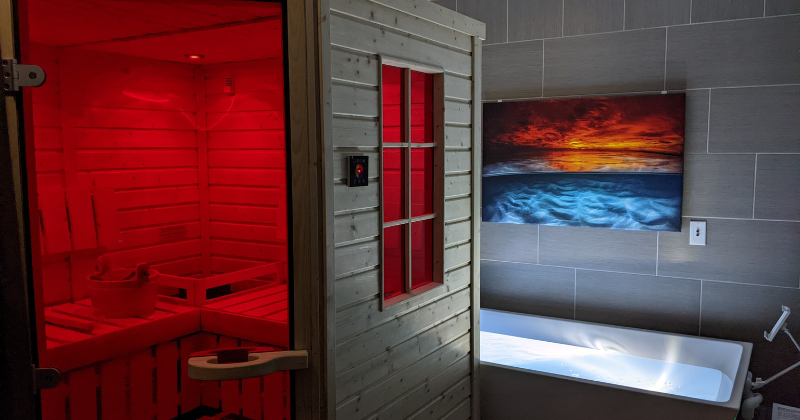
Heat adaptation isn't wellness jargon. It's a well-characterized physiological process that endurance athletes have used for decades to train for hot-weather competition. Consistent heat exposure — sauna, hot bath, or hot-weather training — produces predictable adaptations over roughly two to three weeks:
- Plasma volume increases. Your circulating blood volume goes up, which improves your body's ability to deliver oxygen and clear heat.
- Sweat response improves. You start sweating earlier, sweat more efficiently, and lose less sodium per liter of sweat. Cooling starts happening before your core temperature climbs as high.
- Cardiovascular strain decreases. Your heart rate at any given ambient temperature drops. The same 90°F afternoon feels physically easier.
- Thermoregulatory efficiency improves. Your body gets faster at moving heat from the core outward — the fundamental job of thermoregulation.
This is why sauna use is standard in athletic performance programs, and why researchers describe it as a training stimulus rather than passive relaxation. Your body responds to sauna heat the way it responds to a workout — with adaptation.
And here's the summer connection: those adaptations don't just make your sauna sessions feel easier. They make everyday heat feel more manageable. Yardwork, walks, patio dinners, the drive from the parking lot to the grocery store — all of it gets easier once your thermoregulatory system is trained.
How to Actually Use Sauna in Summer
The research on frequency, duration, and pairing is more consistent than the specific temperature protocols. Here's what practical use looks like based on what the studies actually measured:
How Sauna Fits With Everything Else
Sauna is one input, not the whole picture. Within our wellness stack it pairs naturally with the services already built around it — each one working a different biological angle:
- Cold plunge — Alternating heat and cold is the pattern used in the 2026 immune study and in the traditional Finnish sauna experience. Contrast therapy adds a vascular training component that sauna alone doesn't produce.
- Tonal strength training — The Lee et al. trial specifically paired exercise with post-workout sauna. If you're using our Tonal, the sauna round after is the exact protocol the research studied.
- Red light therapy — Different mechanism, complementary timing. Red light targets cellular energy production; sauna targets circulation and thermoregulation. They pair well without conflict.
- Float therapy — For nervous system down-regulation. Sauna is a controlled stressor; float is the opposite. Alternating between the two across a week is what many of our members do.
Sauna in Lincoln
Traditional Finnish sauna at 195°F. Coed and women's-only options. Free daily with any membership tier, or $13 as a drop-in. Private Fire & Ice suite available for you and a guest.
Book a session → See memberships →