HBOT and Brain Fog
What the research actually shows about hyperbaric oxygen and cognitive function — and, just as importantly, how to read that research honestly before you spend a dollar on it.
Brain fog is one of those things that's hard to describe until you have it. Words slip away mid-sentence. Focus that used to come for free now takes visible effort. You read the same paragraph three times. For a lot of people — recovering from a virus, running on poor sleep, carrying chronic stress, or simply getting older — the brain stops performing the way it used to, and nobody can quite say why.
Hyperbaric oxygen therapy (HBOT) comes up constantly in conversations about brain fog and cognitive recovery. The interest is real, and so is some of the research. But the internet is full of overstatement in both directions — miracle claims on one side, dismissive hand-waving on the other. This post does something different: it walks you through what the actual studies found, where those studies were run, and how to tell whether a claim you're reading is grounded or inflated.
That last skill matters more than any single result. By the end, you'll be able to read an HBOT headline and know what to trust.
Read this first. HBOT at Lost in Float is a wellness service, not a medical treatment. We make no medical claims and do not treat, cure, or prevent any condition. The studies cited below were conducted at clinical pressures and in specific patient populations; our wellness sessions operate differently and are less studied. If you have a diagnosed condition, talk to your provider before starting anything new.
How Oxygen Reaches the Brain Under Pressure
The brain is the most oxygen-hungry organ you have. It consumes roughly 20% of your total oxygen while making up about 2% of your body weight, which makes it unusually sensitive to even small changes in oxygen availability.
Here's the basic physics researchers describe: normally, almost all the oxygen in your blood rides on hemoglobin inside red blood cells. Under increased atmospheric pressure, more oxygen dissolves directly into the blood plasma — the fluid itself. Plasma can travel into areas that crowded red blood cells reach less easily, which is why researchers are interested in tissue where circulation is reduced or inflamed.
Studies looking at why HBOT might affect the brain point to several mechanisms. It's worth being precise here: these are mechanisms observed in research settings, not promises about what any single session will do for you.
- Cerebral blood flow: Imaging studies in clinical trials documented increased blood flow in frontal-lobe regions tied to attention and executive function.
- Growth factors: Research has observed upregulation of signaling proteins such as VEGF and BDNF, which are associated with the formation of new blood vessels and neural connections.
- Inflammation signaling: Chronic neuroinflammation is a common thread in many cognitive complaints. Laboratory and clinical work has documented anti-inflammatory effects at the cellular level under hyperbaric conditions.
- Mitochondrial function: Like red light therapy, HBOT has been studied for its effect on the energy-producing machinery inside cells — relevant because neurons are energy-intensive.
A 2024 review in Frontiers in Neurology (Bin-Alamer et al.) summarized how HBOT may act on the nervous system — through neuroplasticity, neurogenesis, synaptogenesis, angiogenesis, and reduced neuroinflammation. The authors framed HBOT as a promising neuromodulatory approach that warrants further clinical study, rather than a settled treatment. That cautious framing is the honest takeaway: the mechanisms are biologically plausible and worth investigating, and the clinical picture is still developing.
How to Read HBOT Research (The Part Most Articles Skip)
Before any study result means anything, you need three numbers. Almost every misleading HBOT claim online comes from hiding one of them. Learn these and you can audit any article — including this one.
1. Pressure (ATA). "ATA" means atmospheres absolute — how much pressure the chamber holds. Sea level is 1.0 ATA. Most clinical cognitive studies ran at 2.0 ATA. Wellness chambers run lower. Pressure is a core variable, so a result from 2.0 ATA does not automatically transfer to a lower-pressure session.
2. Oxygen concentration — and pressure, the second lever. What reaches your tissue is partial pressure: oxygen concentration multiplied by chamber pressure. Our sessions deliver around 95% oxygen — compared to the 21% in the air you breathe all day — inside a gently pressurized chamber. That's a genuinely oxygen-rich environment. Clinical chambers add a second lever on top: very high pressure, which is what produced the dramatic dissolved-oxygen numbers in studies of severe medical conditions. Both matter. The honest way to read any HBOT claim is to check both the concentration and the pressure behind it — and we're happy to tell you exactly where ours sit.
3. Dose (total hours). The trials that showed cognitive change generally used 40 to 60 sessions — often 25 to 50 total hours. A single session is not what those studies measured. When someone cites a dramatic result, ask how many hours produced it.
Hold those three numbers in mind as you read the studies below. We'll be explicit each time about the pressure, the population, and the dose — because that context is the difference between an honest summary and a sales pitch.
What the Studies Found: Healthy Aging
One of the most cited studies in this area is a randomized controlled trial in Aging (Efrati et al., 2020). It's notable because it studied healthy adults over 64 — not patients with a diagnosis. Sixty-three participants were randomized to HBOT or a control group for three months, at clinical pressure (2.0 ATA).
Brain imaging in the study tracked alongside the cognitive scores: researchers observed increased cerebral blood flow in several frontal-lobe regions that correlated with the measured improvements. It's a well-run trial — and it's also exactly the kind of result that gets stripped of its context online. The honest version always includes the pressure and the session count.
A 2021 mechanistic review in Biomedicines (Shapira et al.) pulled together this kind of evidence and argued that HBOT is an area of active, serious interest for cognitive and brain-aging research — while being clear that more work is needed before strong clinical conclusions.
Brain Fog, Fatigue, and Post-Viral Recovery
Post-viral cognitive symptoms — the cluster many people call brain fog — gave researchers an unusually clear population to study. Difficulty concentrating, slower processing, memory lapses, and word-finding trouble are common after viral illness, and for a meaningful share of people they linger.
A randomized, double-blind, sham-controlled trial in Scientific Reports (Hadanny et al., 2022) assigned 73 patients with persistent post-COVID symptoms to either 40 sessions of HBOT or a sham condition, again at clinical pressure. The HBOT group showed statistically significant improvements in global cognition, attention, and executive function, with effect sizes around 0.46 to 0.50, and brain imaging showed measurable changes in gray-matter blood flow.
A sham-controlled, double-blind design is the gold standard, which makes this an important result. And the same three caveats apply every time: 2.0 ATA, a diagnosed patient population, and 40 sessions. That's what was studied. It tells you the direction is real and worth taking seriously — it does not tell you what a lower-pressure wellness session will do, and we're not going to pretend it does.
Across these trials, the pattern is consistent: at clinical pressure, over many sessions, in defined populations, HBOT was associated with measurable cognitive improvement confirmed by imaging. That's a genuinely encouraging body of evidence. What it does not establish is that lower-pressure wellness HBOT reproduces those numbers — that comparison simply hasn't been run at the same rigor. Anyone telling you otherwise is selling, not summarizing.
Who Tends to Be Curious About HBOT for Brain Fog
People come to HBOT for cognitive reasons from a handful of recognizable situations. None of the below is a claim that HBOT will resolve these — it's a map of who tends to be interested, and the mechanism researchers point to in each case.
How HBOT Fits With the Rest of Your Routine
For brain health, HBOT isn't a standalone fix — it's one input alongside the things that move the needle most (sleep, movement, nutrition, stress). Within a wellness routine, it pairs naturally with our other services, each working a different angle:
- Float therapy — Quiets mental noise and is associated with reduced cortisol and theta brainwave states linked to rest and creativity. Float and HBOT address mental clarity from different directions: nervous-system calm versus oxygenation.
- Red light therapy — Studied for its effect on cellular energy production. A natural complement to HBOT's focus on oxygen delivery.
- Sauna — Regular sauna use is associated with favorable long-term brain-health outcomes in Finnish population research, making heat a sensible companion to a recovery routine.
- Cold plunge — Cold exposure triggers a norepinephrine response associated with alertness and mood. Many people like it for immediate mental sharpness.
HBOT in Lincoln
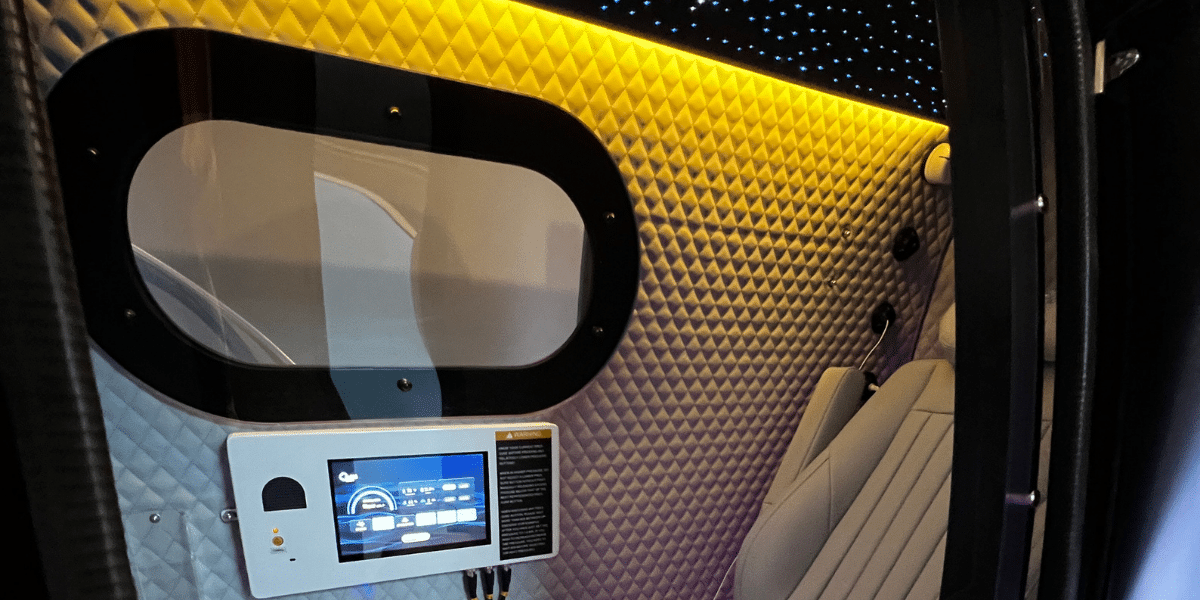
Seated reclining chamber. 60-minute sessions. TV available. Gold & Platinum members can use membership credits toward HBOT. Bronze & Silver members receive 50% off every session.
Book a session → Learn about HBOT →Frequently Asked Questions
Bin-Alamer O et al. (2024) — HBOT as a neuromodulatory technique: a review of recent evidence. Frontiers in Neurology.
Efrati S et al. (2020) — Cognitive enhancement of healthy older adults using hyperbaric oxygen: a randomized controlled trial (2.0 ATA). Aging.
Hadanny A et al. (2022) — HBOT improves neurocognitive functions and symptoms of post-COVID condition: randomized, sham-controlled trial. Scientific Reports.
Shapira R et al. (2021) — Hyperbaric oxygen treatment: from mechanisms to cognitive improvement. Biomedicines.