If you're trying to change your body composition — lose fat, build muscle, or both — there's a thousand things competing for your attention. Trainers, supplements, machines, protocols, modalities, gadgets. It's a lot.
So we want to be straight with you up front: most of body composition comes down to four things, in roughly this order of importance — nutrition, resistance training, sleep, and consistency. When those are dialed in, the modalities below will dramatically accelerate your results.
And — this is important — if your circumstances mean some of those foundations aren't currently possible, the modalities can still meaningfully help. Many people we work with come to us because traditional exercise is off the table for now. Maybe you're recovering from surgery, managing chronic pain, dealing with a hormonal condition, navigating a high-stress season of life, or just rebuilding your baseline after a long stretch where wellness hasn't been a priority. Sauna, cold plunge, and red light therapy can support hormone balance, metabolic function, stress regulation, and recovery in ways that help your body get to a place where the foundational work becomes possible. They're a real on-ramp, not just an amplifier.
That said, the modalities we offer at Lost in Float do have peer-reviewed effects on body composition that are strongest when stacked on top of the basics. Some are far more impactful than others. This guide walks you through what each one actually does, what the research shows, and how to put them together — whether you're optimizing on top of a solid foundation or rebuilding from the ground up.
We sell sauna, cold plunge, red light, cryo, contrast therapy, float, HBOT, and Tonal sessions. We have an obvious bias. We also believe none of these are magic, and the worst thing we could do for you is sell you a story where they are. This guide is what we'd tell our own family.
The Four Things That Actually Move the Needle
Before we talk about modalities, the foundations. These do 80–90% of the work in any body composition change, and skipping them in favor of "the stack" is the #1 reason people spin their wheels for years.
Nutrition (the biggest lever, by far)
Body composition lives and dies by what you eat. For fat loss, you need a sustained calorie deficit. For muscle gain or muscle preservation during a cut, current research consistently lands on roughly 1 gram of protein per pound of bodyweight as a practical target — and there's growing evidence supporting up to 1.2 g/lb when you're in a calorie deficit, since higher protein helps preserve muscle as you lose fat. The International Society of Sports Nutrition's position stand puts the range at 2.3–3.1 g/kg (≈1.0–1.4 g/lb) for resistance-trained people in a deficit. Whole foods, mostly. Vegetables, lean proteins, fruit, fiber. Boring, effective.
Three reasons protein is the macro that punches above its weight for body composition. One — the thermic effect. Your body uses 20–30% of the calories in protein just digesting and metabolizing it, compared to 5–10% for carbs and 0–3% for fat. Eat 200g of protein and your body burns roughly 160–240 calories just processing it. Two — satiety. Protein is the most filling macro per calorie. It triggers satiety hormones (PYY, GLP-1, CCK) and suppresses ghrelin, which is the hormone driving hunger. Higher protein intake reliably reduces total daily calorie consumption in study after study, even when participants are eating freely. Three — muscle preservation in a deficit. When calories are low, your body looks for energy anywhere it can find it, including muscle tissue. Adequate protein tells your body to spare the muscle and burn the fat instead. Without it, a meaningful chunk of every pound you lose comes from muscle — which lowers your metabolic rate and makes the next pound harder to lose. The right amount of protein turns weight loss into fat loss.
Resistance Training (the muscle-saving variable)
Lifting heavy things — or pulling against resistance — is what tells your body to keep its muscle while you're losing fat. Without it, a chunk of every pound you lose comes from muscle, which is the exact opposite of what most people actually want. 2–4 sessions a week, focused on compound movements (squats, deadlifts, presses, rows), is the difference between "lost weight" and "lost fat."
Sleep (the multiplier nobody respects)
Short sleep tanks growth hormone, raises cortisol, scrambles hunger hormones (leptin and ghrelin), and makes resistance training measurably less effective. Studies of dieters who slept 5.5 hours vs. 8.5 hours showed the short-sleep group lost more than half of their weight from muscle instead of fat. Same diet, same calorie deficit. Sleep was the variable.
Consistency (the only one that compounds)
A perfect plan you do for three weeks loses every time to a decent plan you do for three years. Body composition is a long game, not a sprint, and the modalities below are most useful when they're tools that help you stay consistent — not interventions you white-knuckle through.
If those four things are working for you, what we're about to walk through can absolutely amplify them. If they aren't all in place yet — for whatever reason — the modalities can still meaningfully support your body, regulate stress, balance hormones, and help you build toward the foundations over time. Start where you are, with what's possible.
Where Recovery Modalities Actually Help
Here's the honest framing for everything that follows: the tools below help with body composition through three indirect-but-real pathways.
- Hormonal support — heat, cold, and red light all influence growth hormone, cortisol, and metabolic signaling in measurable ways.
- Recovery and training capacity — better recovery means more, harder, more consistent training, which is where actual body composition change happens.
- Stress regulation and sleep — chronic stress and poor sleep are massive drivers of stubborn body fat (especially visceral fat). Tools that move these needles move body comp downstream.
None of them are fat-loss buttons. All of them, used well, can stack with the basics and make the work pay off faster.
If you've been doing the basics consistently and your body composition still isn't moving, the missing variable is often stress. Chronically high cortisol blocks fat loss, drives visceral fat storage, scrambles sleep, and increases cravings for calorie-dense food. You can't fix a stress-driven plateau by adding more discipline — you have to address the nervous system. Pay close attention to the float therapy section below; it's specifically built for this person.
The Modalities, Honestly Reviewed
If you only use one thing in this guide, use this one. Tonal 2 is a digital strength machine that uses electromagnetic resistance up to 250 lbs to deliver real, programmed strength training — without the racks, plates, and time-cost of a traditional gym. Sessions are typically 20–40 minutes, the form coaching is built in, and the resistance auto-adjusts based on your strength curve.
For body composition specifically, this is the modality that actually builds and preserves muscle, which is what determines whether your weight loss looks like fat loss or like getting smaller-but-softer. There is no recovery modality that substitutes for actual progressive resistance training. Tonal is the closest thing to "I will go lift" without the friction that stops most people from going to lift.
The sweat you lose in the sauna is mostly water — that part isn't fat loss, and it'll come back as soon as you rehydrate. But the real body composition story for sauna is hormonal. Multiple peer-reviewed studies have shown 2–5x increases in growth hormone after sauna sessions, with some specific protocols pushing far higher. Growth hormone is directly lipolytic, meaning it tells your body to mobilize fat for fuel while sparing muscle — exactly what you want during a fat-loss phase.
Sauna also lowers cortisol over time, which matters because chronically elevated cortisol drives visceral (belly) fat storage. And it's the closest thing to a passive cardiovascular workout we have — your heart rate climbs into a moderate cardio range without you doing anything.
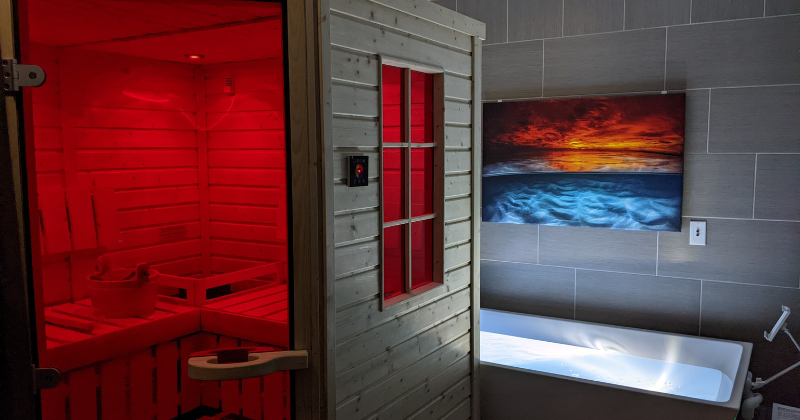
Our sauna runs at 195°F, traditional Finnish style — within the temperature range where the longevity and hormonal research was actually conducted. Full protocol here.
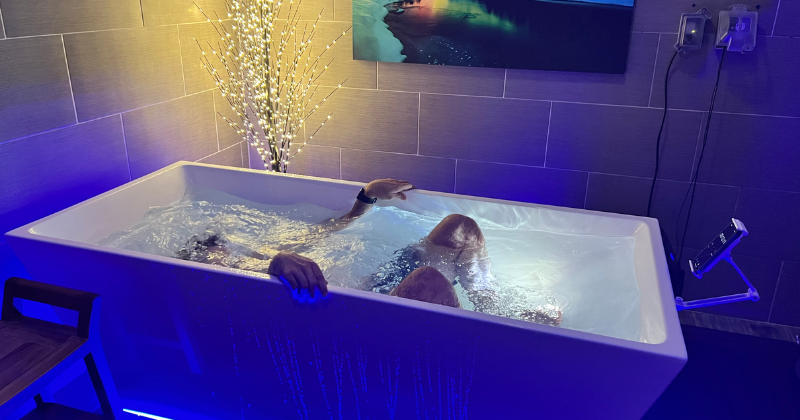
Cold exposure activates brown adipose tissue (BAT) — a metabolically active type of fat that burns energy to generate heat. With consistent cold exposure, you can grow more BAT and increase your resting metabolic rate. There's also a substantial norepinephrine spike during cold exposure, which mobilizes fat and improves focus.
Here's the honest part: cold exposure increases energy expenditure, but several studies have shown the body often compensates by increasing appetite, which can blunt the net body comp effect if you're not paying attention to your eating. The metabolic and mood benefits are still real — the cold-water-makes-you-skinny narrative just isn't quite that simple.
Where cold plunge really earns its place in a body comp routine is stress regulation, mood, and recovery. Lower stress, better sleep, more training capacity. Those are real levers, even if the direct calorie burn is smaller than the marketing suggests.
If you're trying to build or preserve muscle, do not cold plunge in the hours after resistance training. A 2024 meta-analysis (Piñero et al., European Journal of Sport Science) confirmed what earlier studies suggested: cold water immersion after lifting blunts muscle hypertrophy by interfering with the inflammatory and anabolic signaling that drives muscle growth. Strength gains are mostly preserved, but actual muscle fiber growth is reduced. Cold plunge BEFORE resistance training — or on rest days — sidesteps this problem entirely. Aim for at least 4–6 hours between a cold plunge and a strength session if you can. This concern is specific to resistance training only. After cardio (running, cycling, rowing, walking, HIIT, anything that's not lifting heavy things), cold plunge or cryo is genuinely fantastic — it accelerates recovery, reduces soreness, and clears metabolic waste from working muscles without any of the muscle-blunting downsides. Plunge or cryo away after a run.
Our plunge sits at 45–50°F. More on cold plunge here.
Going hot to cold to hot, in cycles, gives you the benefits of both modalities plus a vascular response that neither produces alone. Your blood vessels rapidly dilate (sauna) and constrict (plunge), which acts like a workout for your circulatory system and dramatically accelerates recovery from training.
For body composition specifically, contrast therapy is one of the more efficient ways to stack the hormonal benefits of heat with the metabolic benefits of cold in a single visit. We see members who couldn't fit two separate sessions into their week stay consistent with one combined session — and consistency is the variable that actually compounds.
Standard protocol: 3 rounds of about 10–15 minutes sauna followed by 1–3 minutes plunge. End on cold if your goal includes brown fat activation; end on hot if you're prioritizing parasympathetic recovery before sleep — or if you're lifting later that day, in which case finishing on heat avoids the same post-workout-cold issue we just covered (see cold plunge timing above).
This is the one with the most direct body-contouring research, and also the one most prone to overhype. Multiple randomized, sham-controlled trials have shown measurable circumference reductions (waist, hips, thighs, arms) with red light at specific wavelengths — typically 635–680nm — applied locally over 4–6 weeks. The mechanism: red light triggers transient pores in fat cells, allowing them to release stored triglycerides, which are then metabolized.
The honest caveat: this works best when paired with exercise. The red light helps fat cells release their contents; your body still has to actually use those mobilized fats as fuel, which means moving your body. As a passive standalone treatment, the effects are real but modest. As a pre-workout primer or post-workout recovery tool combined with consistent training, it's measurably more useful.
Red light also accelerates muscle recovery, reduces soreness, and supports skin quality during weight loss — which matters when rapid fat loss can otherwise leave skin looking less elastic.
Cryotherapy uses extreme cold — -220°F to -240°F — for very short exposures (2–3 minutes). It's the same family of effect as cold plunge, but more intense and shorter. The body's response is bigger and faster: a sharper norepinephrine spike, a dramatic anti-inflammatory effect, and significant calorie burn during the rewarming phase.
For body composition, cryo's most useful contribution is recovery acceleration after hard training, plus the stress-regulating effects of the norepinephrine response. It's not a fat-loss treatment by itself, and we'd never sell it as one. It's a tool that lets you train harder, more often, with less downtime — and that's where the body comp benefit shows up.
If you're choosing between cryo and cold plunge for body comp purposes, water cold has slightly more research support for BAT activation specifically. Cryo wins for time-efficiency and post-workout recovery.
Same lifting caveat as cold plunge: if you're going to do cryo on a resistance training day, do it before the lift, not after. The same muscle-hypertrophy-blunting concern applies. After cardio, though? Cryo is excellent — knock yourself out.
Float doesn't have direct fat-loss research, and we won't pretend otherwise. What it does have is some of the strongest research available for cortisol reduction, parasympathetic activation, and sleep quality improvement. And for one specific group of people, that's the entire ballgame.
If your weight loss has stalled and you've been doing everything else "right" — eating well, training, hydrating, getting enough sleep on paper — there's a real chance the missing variable is stress. Chronically elevated cortisol blocks fat loss in a few specific ways: it drives visceral (belly) fat storage, increases cravings for high-calorie food, disrupts sleep architecture (which independently impairs fat loss), and makes your body cling to weight as a protective response to perceived threat. You can't out-diet a nervous system that's stuck in fight-or-flight.
Float therapy is one of the few interventions with strong, peer-reviewed evidence for shifting the nervous system out of that state. Studies have shown significant cortisol reductions, lower blood pressure, and measurable improvements in anxiety and sleep — often after a single session, with stronger effects from a regular practice. For the stressed-out, burned-out person whose body comp won't budge, this is the modality that addresses the actual root cause.
The honest framing: float won't do anything for someone whose nutrition or training is the real problem. But for the person who's grinding without results because their stress is the bottleneck, it can unlock the whole chain.
HBOT is the newest service we're adding, and we want to be especially careful about how we talk about it for body composition. Here's the honest picture.
HBOT involves breathing higher-than-normal concentrations of oxygen in a pressurized environment. Most of the strongest research is in wound healing, traumatic brain injury recovery, and post-stroke recovery — not body comp. The metabolic research is real but earlier-stage: a recent (2025) systematic review of HBOT for metabolic disorders found preclinical and small clinical trials showing improvements in insulin sensitivity (one human study showed a 25–30% increase after just five sessions), reduced adipose tissue inflammation, and improved lipid profiles. The authors explicitly noted that more high-quality trials are needed before drawing strong conclusions.
Where HBOT likely contributes to body composition isn't fat-burning directly — it's by improving insulin sensitivity, reducing systemic inflammation, and accelerating recovery from training. Better insulin sensitivity means your body partitions calories better (more toward muscle, less toward fat storage). Lower inflammation means your training pays off more. Faster recovery means more training capacity. None of those are headlines, but all of them stack with the rest of the work.
We're including HBOT in this guide because the early evidence is genuinely promising — but if someone tells you a hyperbaric chamber is going to melt fat off your body, they're getting ahead of where the science actually is. Use it as a recovery and metabolic-health tool, not as a fat-loss treatment.
How to Stack Them: Pick Your Level
You don't have to do everything. Pick the level that matches the time you actually have, build the habit, and trade up when you're ready. The order matters — cold goes before Tonal (not after), sauna and red light come after the lift to maximize recovery without blunting the muscle-building signal.
The Once-or-Twice-a-Week Anchor
30–60 minutes, 1–2x per week. Tonal (20–30 min) as the main focus. Add a cold plunge before, or sauna/red light after, when time allows. This is the bare minimum that still moves the needle on body composition. Don't underestimate it — twice a week consistently beats five times a week sporadically.
The Short-Session Builder
A few 20–30 minute sessions per week. Tonal workout (20–30 min) with an optional cold plunge or cryo before, and sauna or red light after as time permits. This is the sweet spot for busy professionals — short, efficient, repeatable. Real strength and body comp progress lives here.
The Focused Routine
3–4 focused sessions per week. Cold plunge before Tonal, then sauna, finished with red light therapy when time allows. This is the protocol where most people see their fastest body composition changes. Enough volume to build real muscle, enough recovery support to keep showing up.
The All-In Protocol
3–4 sessions per week, 45–70 minutes each. The full stack:
- Cold — 1–3 min plunge at 45–50°F or 2–3 min cryo
- Tonal — 20–40 min, builds muscle and raises metabolic rate
- Sauna — 15–20 min
- Red light therapy — ~15 min full-body
- Float or HBOT — 60 min, once per week when possible for optimization
This is for the person who's ready to make body composition a real priority and has the time to invest. Not the starting point — the destination after you've built the habit at one of the levels above.
Whichever level you start at, the foundational rule stays the same: cold before lifting, heat and red light after. That ordering protects the muscle-building work you're doing and stacks every benefit on top instead of canceling them out.
Everything is included with one membership
Unlimited sauna, cold plunge, contrast, red light, cryo, float, HBOT, and Tonal — depending on tier. From $69/month.
See memberships → Book a single sessionCommon Mistakes We See
A few patterns we watch people fall into. Avoiding these will save you months.
Expecting the modalities to do all the work alone
If the basics — nutrition, training, sleep — are within reach for you, modalities work best when they're stacked on top, not used as a substitute. The fastest results come from doing both. That said, if circumstances mean the basics aren't fully possible right now, the modalities can absolutely still help your body get to a healthier baseline, and they're worth using on their own. Just be honest with yourself about which situation you're in, and adjust your expectations accordingly.
Stopping after three weeks because nothing is "happening"
Body composition changes are slow and they show up unevenly. The scale lies, day-to-day weight is noise, and the first month of any new routine is when most people quit before the change becomes visible. Take photos. Take measurements. Don't trust the scale alone.
Going too hard, too fast
Stacking sauna, cryo, contrast, and red light into a single week when you've never done any of them is a great way to feel terrible and quit. Start with one or two, build the habit, then layer.
Cold plunging right after lifting
This one is critical and most people get it wrong. The instinct is to plunge after a brutal Tonal session because it feels like the perfect recovery — and you'll feel great immediately. But the research is clear: cold immersion in the hours after resistance training blunts the muscle-building signal that your workout just created. A 2024 meta-analysis confirmed cold plunging post-lift reduces hypertrophy compared to lifting alone. If muscle is part of your goal — and for body composition it absolutely should be — plunge before you lift, not after. Or save the cold for non-training days. Strength gains are mostly preserved either way; it's specifically muscle growth that takes the hit. To be clear: this only applies to lifting. Cold plunge or cryo after cardio (running, cycling, rowing, HIIT, yoga, etc.) is genuinely great — accelerates recovery, reduces soreness, no downside. The "no cold after" rule is a resistance training rule, not a general one.
Eating around the workout
Earning a sauna session and then a Tonal workout doesn't unlock the right to eat 800 extra calories of cookies that night. Half of fat loss is the eating, and the other half is the not-eating-the-thing-you-thought-you-earned. We say this kindly. We've all done it.
Realistic, sustainable fat loss is roughly 0.5–1% of bodyweight per week. For a 180-pound person, that's about 1–2 pounds. Anything dramatically faster is usually water and muscle, not fat — and it tends to come back. Slow is the cheat code.
If You're Just Starting Out
If this whole stack feels overwhelming, here's the simplest possible starting point that we'd actually recommend. Adjust based on what's possible for you — the goal is to get a few easy wins on the board.
- Get nutrition close to right. Plenty of protein, plenty of vegetables, less of everything else. You don't need an app or a plan. You need a default.
- Move your body in whatever way you can. If lifting is possible, twice a week with Tonal or any traditional gym setup is the gold standard. If it's not, walking, swimming, gentle yoga, or physical therapy work all count. Movement is the lever — the form doesn't have to be perfect.
- Sauna 3x a week, 15–20 minutes per session. The single highest-leverage recovery addition, and it works whether or not you can train hard.
- Sleep more. 7+ hours, dark room, regular schedule. Boring, free, dramatic.
That's it. Do that for two months and reassess. If it's working — and it will, if you actually do it — you can add cold, contrast, red light, and the rest. If progress is slower than you hoped, look at the foundations first before adding more modalities. The answer is almost always there.
How We Run It at Lost in Float
A few things that matter for anyone considering training and recovering with us:
- Everything in one place. You don't need three memberships at three facilities. Sauna, cold plunge, contrast, red light, cryo, float, HBOT, and Tonal are all under one roof at 8244 Northern Lights Dr.
- One membership, no per-session fees. Membership pricing is built so frequency isn't a financial calculation — because frequency is what makes any of this work.
- Spotless and consistent. Every modality runs in the same range, every time. The plunge is 45–50°F. The sauna is 195°F. The cryo is the cryo. The space is clean enough that members mention it without being asked.
- No upsells, no pressure. If sauna is the only thing you ever use, that's fine. We'd rather you do one thing consistently than four things sporadically.
Body composition change is mostly a quiet, unsexy process of doing the basics for longer than you think you should have to. The right tools make that easier and more enjoyable. That's all we're trying to do here.
Lost in Float | 8244 Northern Lights Dr, Lincoln NE | 531.289.7739 | Open Tuesday–Sunday 9am–9pm